10 GHz update - May 2026
May 18, 2026
I finished building and testing the 10 GHz 25 W GaN PA at the end of February and installed it at the dish on 2 March. My first QSO was with ON5TA -16/-17, followed by OZ1LPR -2/-16, GW3KTH -19/-22 and IW2FZR -16/-18.
20 - 23 March
Between 20 and 23 March I added 13 new initials, including the T7/IW2BNA DXpedition to San Marino on 22 March.
#30 20/03/2026 15:45 I6YPK           JN72DJ -22      -21
#31 21/03/2026 14:47 W3TI            FN22   -23      -21
#32 21/03/2026 15:33 DJ7FJ           JN48   -15      -18
#33 21/03/2026 15:51 YO2LAM          KNØ5PS -12      -22
#34 22/03/2026 12:46 T7/IW2BNA       JN63   -20      -21
#35 22/03/2026 13:02 OM4XA           JN98HS -19      -18
#36 22/03/2026 13:28 IK3GHY          JN65   -18      -18
#37 22/03/2026 14:55 SA6BUN          JO78CP -10      -14
#38 22/03/2026 15:43 G4BAO           JOØ2CG -18      -22
#39 22/03/2026 16:39 VE4MA           EN19LU -15      -17
#40 22/03/2026 17:48 PA3BYV          JO32NX -19      -21
#41 23/03/2026 12:51 IZ4BFA          JN54LP -18      -19
#42 23/03/2026 13:23 IZØJNY          JN61   -19      -22
ARI EME Contest - Spring Session
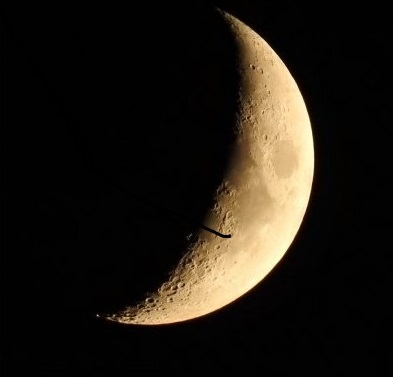
There were some good moon conditions the week before the ARI EME Contest and I managed to work another 6 new initials.
Activity on 10 GHz during the ARI Contest wasn’t as high as I thought it might be and I didn’t work anyone from North America which was a surprise. I split my operating time between 144 MHz and 10 GHz, and managed to complete 11 QSO’s on 10 GHz including 2 new initials.
#43 19/04/2026 14:57 G4HSK           JOØ1FS -20      -20
#44 19/04/2026 16:41 K5DOG           EMØØ   -21      -18
#45 20/04/2026 18:10 OE5VRL          JN78DK -16      -16
#46 24/04/2026 15:38 PE1CKK          JO22OF -12      -17
#47 24/04/2026 15:53 PE1MMP          JO21US -18      -17
#48 24/04/2026 16:07 LZ4OC           KN33GN -17      -19
#49 25/04/2026 17:45 IZ2DJP          JN55FO -15      -14
#50 26/04/2026 19:57 IW2BNA          JN45XS -19      -22
14 - 17 May
I completed 26 QSO’s between 14 and 17 May and added 7 new initials. Conditions were excellent during the Dubus contest on 16 May and I copied OZ1LPR, SP6JLW and IK3MAC on CW. I tried calling, but the combination of low power and the small dish was not quite enough to be heard.
#51 14/05/2026 13:31 SA5IKN          JO89TT -22      -25
#52 16/05/2026 13:23 SM5DGX          JO89NV -17      -13
#53 16/05/2026 13:31 UT4UWR          KO5ØFL -19      -20
#54 17/05/2026 11:14 SP3XBO          JO81   -17      -16
#55 17/05/2026 11:20 SM6CKU          JO67CK -15      -14
#56 17/05/2026 12:28 S57NML          JN76OD -21      -24
#57 17/05/2026 14:28 PAØJOZ          JO22FF -20      -25
Problem solving
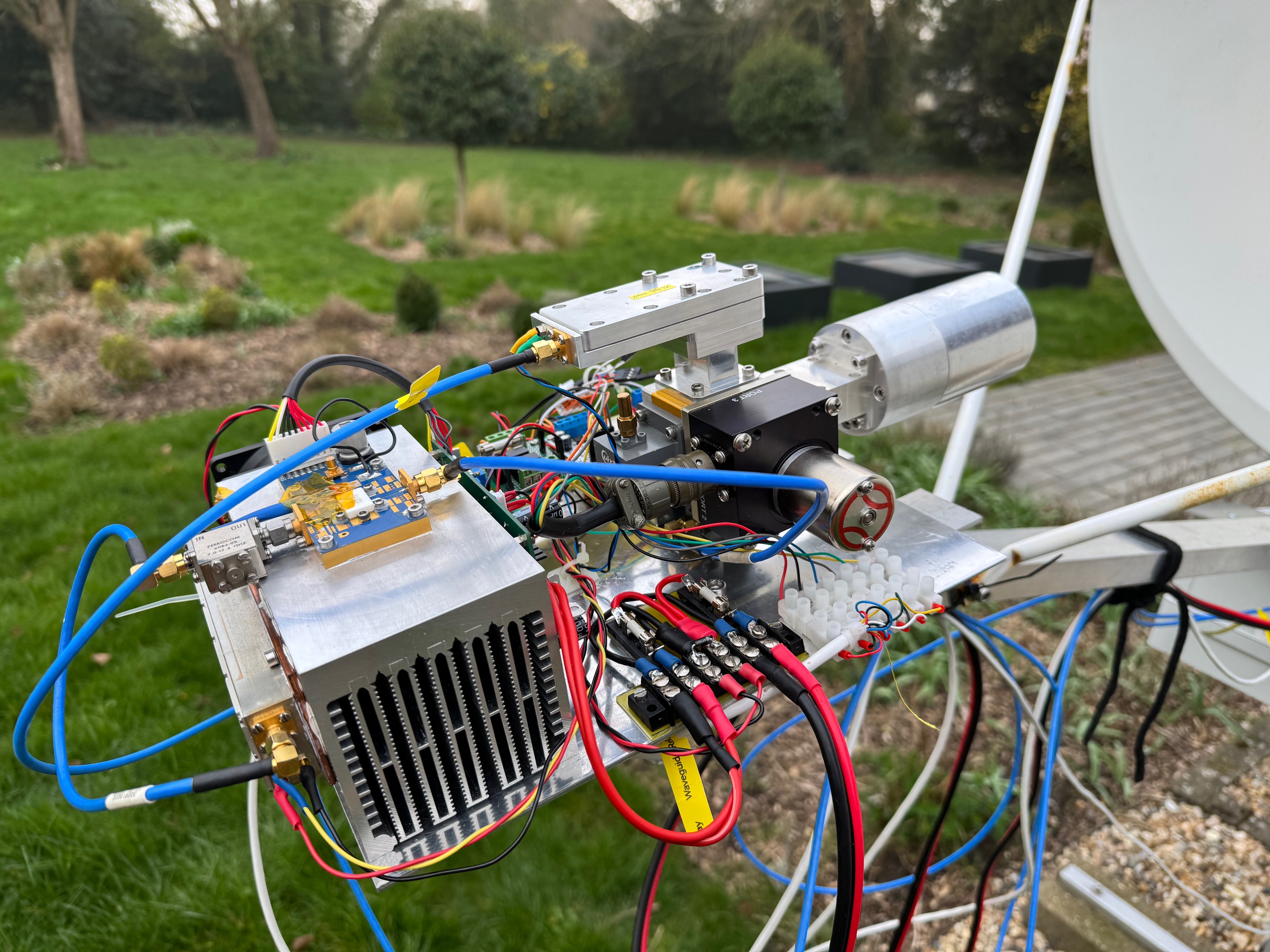
I use an Arduino-based sequencer to control the waveguide switch, PA, transverter, and transmit inhibit circuit. During some operating sessions, the Arduino would occasionally reboot at random, before continuing to function normally. I suspected electrical noise was coupling into the reset pin, so I added a 1 kΩ pull-up resistor and a 100 nF capacitor directly at the device. I also fitted additional snubber diodes across the waveguide switch relay at the feed tray and added snap-on ferrite cores to the control cables at the sequencer end. Hardening the reset pin and control lines appears to have solved the problem.
Another issue appeared when the temperature dropped below 10 °C, where the waveguide switch would sometimes fail to change over correctly. This was resolved by increasing the 24 V relay drive pulse from 60 ms to 100 ms.
The Arduino sequencer unit also contains a pair of SPDT relays and a three-way splitter, allowing me to use an SDRPlay RSP1 and a moon noise meter alongside the IC-705. These relays had been causing intermittent receive problems for some time before I eventually discovered the cause. I had originally wired them with the normally closed contacts used for transmit and the normally open contacts used for receive. These are fail-safe SMA relays, and I had not appreciated that keeping the control voltage continuously applied during long receive periods could cause intermittent operation due to heating. After rewiring the relays so that receive uses the normally closed contacts, the problem has not reoccurred.