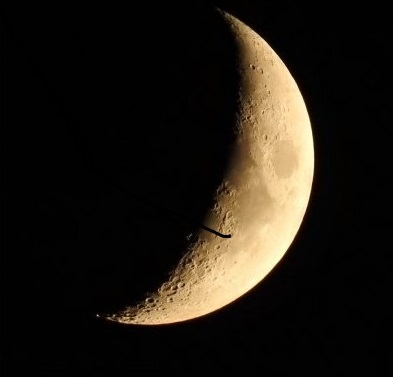
ARRL EME Contest - August 2026
Aug 23, 2026
A few weeks before the first weekend of the 2.3 GHz and Up ARRL EME Contest I moved the 1.2 m offset dish I use for 10 GHz EME back to the rear garden. I had spent some time evaluating both positions and came to the conclusion that having more moon time towards the east would be better.
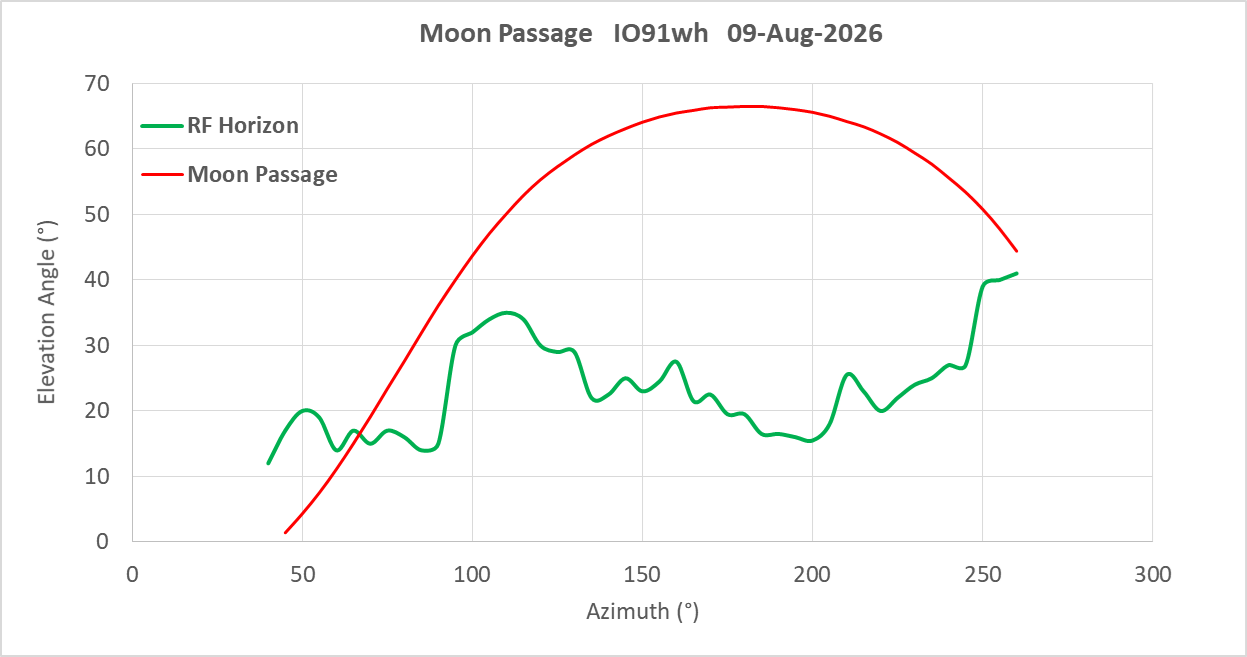
With the dish in the new position I took some sun noise measurements to calibrate the slew drive and then completed a sky survey. I have used SkyScanner by OZ9AAR on 144 MHz but haven’t yet figured out a way to hook it upto my standalone K3NG controller. To complete the survey I used SDR Console in continuum mode, elevated the dish so that it was clear of any obstructions and lowered it until the noise level increased 1-2 dB. I repeated this at 5 degree steps from 40 degree to 260 degrees azimuth. The Excel chart shows the approximate unobstructed RF horizon at 10 GHz and moon passage on the second day of the contest.
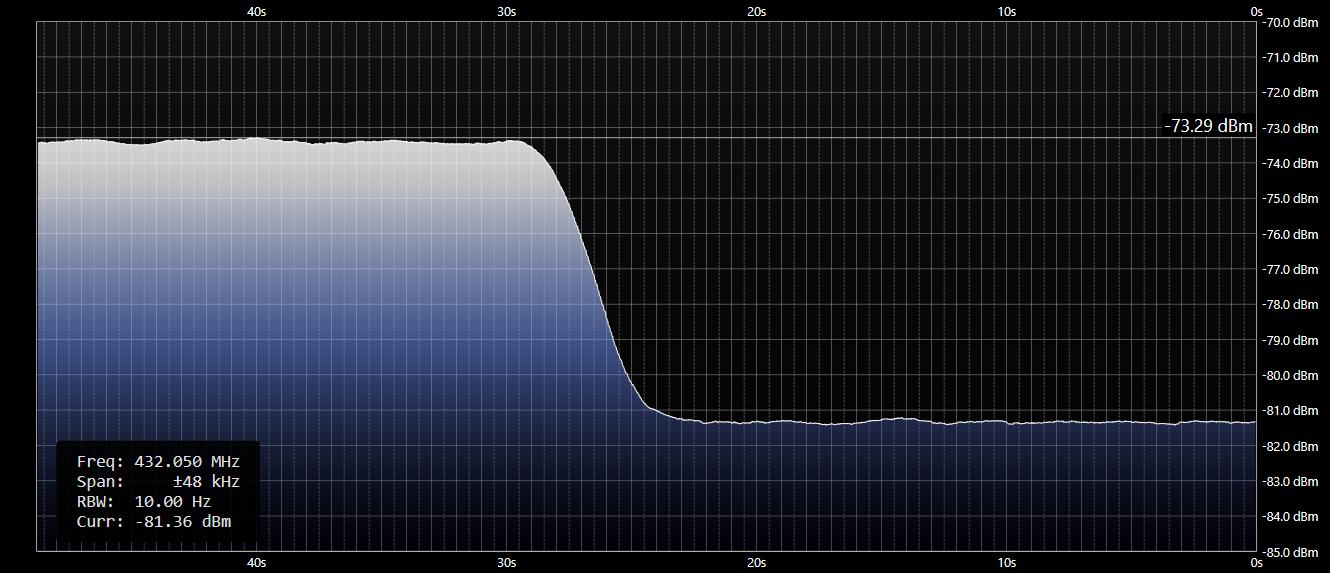
On 7 Aug 2026 I took some sun and moon noise measurements. Tsun/Tsky = 7.9 dB, SFU @ 10 GHz = 315, EMECalc Tsun/Tsky = 8.14 dB, Tmoon 0.5 dB. There was a little activity and I completed QSO’s with OZ1FF -13/-16 and IK3GHY -18/-17.
During the contest there were good conditions and a high level of activity for both moon passes. The afternoons were very hot and I kept a close eye on the PA temperature but thankfully Murphy stayed away and with everything performing well I completed 34 QSO’s on 10GHz, including 3 new initials. I was very pleased to work SV3AAF for a new DXCC and NJ6D was a great signal from his home QTH with a 1m dish. I received a -13 report from JA1WQF but don’t have 10.45 GHz receive capability yet, hopefully we’ll be able to complete a QSO next month.
8 Aug 2026: OZ1LPR, OK2AQ, OH3LWP, OK1DFC, ON5TA, OZ1FF, YO2LAM, LZ40C, IK3GHY, IK6CAK, OM4XA, G4HSK, SA6BUN, W3SZ, DL4DTU, IK0HWJ, AC0RA, KM0T, N1AV
9 Aug 2026: PA3DZL, OE9ERC, DF5MO, OH1LRY (#66), F5JWF, PA3CSG (#67), IW2FZR, G4RFR, UN6PD, SV3AAF (#68) (DXCC #26), IZ2DJP, NJ6D (#69), PE1CKK, VE4MA, OK1KIR
All QSOs were completed using digital modes with a 1.2 m offset dish, 20 W PA and DU3T LNA.